
Topeka, KS · Garage Door Service
Garage Door Repair for Carbondale's 1970s-Era Garages
Most Carbondale garages date to the mid-1970s with original extension-spring hardware. We drive out from Topeka, 15 miles away, to fix what that era's doors actually break.
- Repairs & new doors
- Springs & openers
- Serving 8 nearby communities
Why This Fails Locally
The typical garage door in Carbondale went up around 1975, which puts it in the middle of the wider service area's 1961-1990 housing wave, but a couple years past the area-wide median of 1973. That matters because doors built in the mid-70s around here are almost always single-layer steel, uninsulated, hung on extension springs that run along the horizontal track instead of a torsion spring over the header. Builders in this stretch of Kansas hadn't widely switched to torsion setups yet, and a lot of these original panels and tracks are still in place forty-plus years later.
That hardware wasn't built for much beyond the job it had on day one. Extension springs stretch and sag with age, the galvanized coating on the cables and pulleys wears thin, and the panels themselves - thin steel with a layer of foam at best - dent and bow in ways that insulated doors from the last twenty years just don't. This is the starting point for almost every call we take from this side of the county: not a modern opener glitch, but original 1970s steel and springs finally giving out.
We cover Carbondale from Topeka, about 15 miles out, so when we talk about what fails here we're talking about what that specific generation of door does at this age, not a generic list of garage door problems.
What It Costs
We don't have Carbondale-specific pricing to post on this page, and we're not going to guess at a number just to fill the space. What we can tell you is what drives the cost on a 1975-era door: extension spring systems use two springs instead of one torsion spring, so a full spring replacement here often means replacing a pair, plus the safety cables that should have been added later if the originals never got them. Panel replacement on a door this old is complicated by the fact that nobody stocks 1970s steel panel profiles anymore, so a single damaged section usually means replacing the whole door rather than matching one panel.
Household income in this part of the service area runs a bit under the area-wide median of $71,875, and we mention that only because it's part of why a repair-versus-replace call matters here more than in a newer subdivision: spending money shoring up original hardware that's going to need the same work again in a few years isn't always the better use of it. We'll tell you plainly when a repair is the right move and when it's throwing money at a door that's done.
The DIY Question
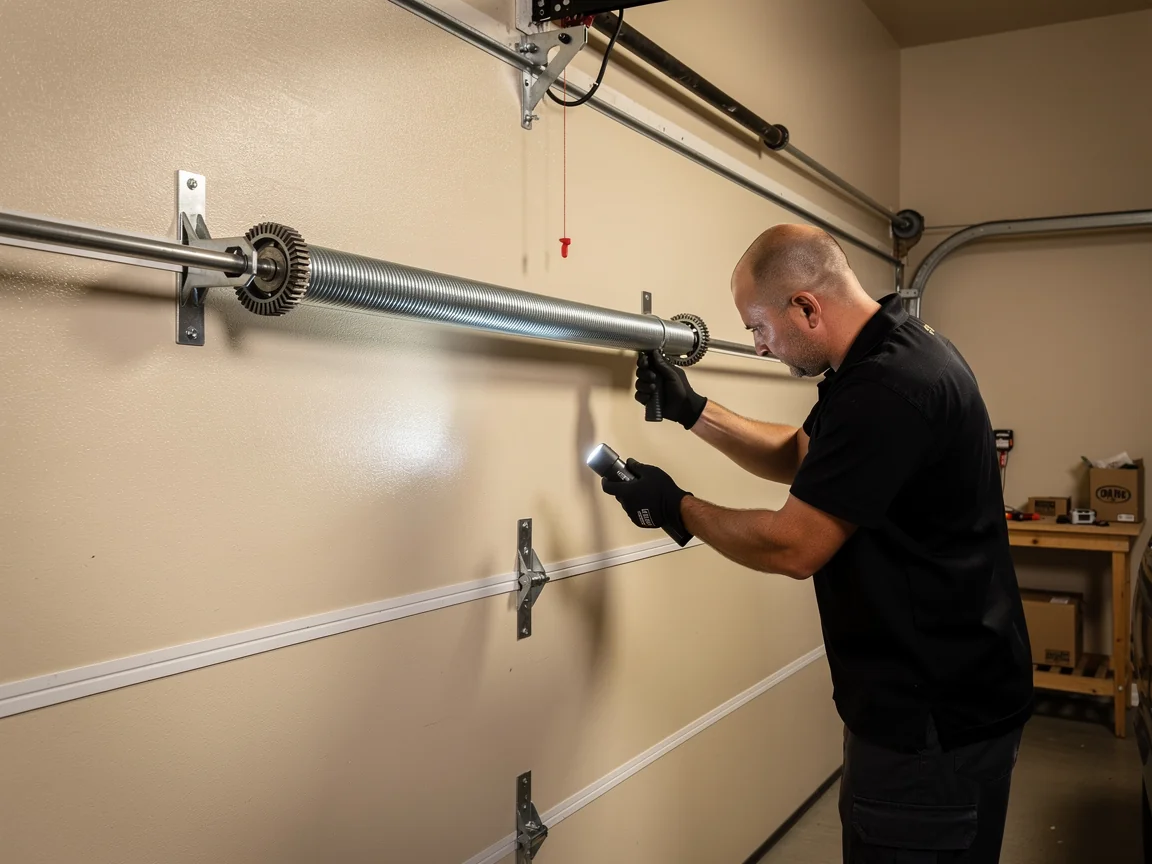
Extension springs are the ones that hurt people. Unlike a torsion spring wound tight on a shaft over the door, an extension spring stretches under load along the track, and if it lets go while you're working near it, it comes off that track with real force. That's the hardware on most original Carbondale doors from this era, and it's not the system to learn on.
There are smaller jobs on a door this age that a reasonably handy homeowner can do - tightening loose hinges, lubricating rollers, replacing a worn weatherstrip along the bottom. But once you're talking about the springs, the cables, or the drums they wind onto, you're working against stored tension that doesn't forgive a mistake. Given how many of these doors around Carbondale are still running their original extension-spring setup without the safety cables that later became standard, this is the one area where we'd rather you call than improvise. It's an honest limitation of DIY here, not a sales pitch: the hardware itself is the problem, not your ability to use a wrench.
What Can Go Wrong
On a door built around 1975, the failures cluster in predictable places. The extension springs stretch out of tension over the decades and stop lifting the door evenly, so one side drags or the door tips at an angle as it opens. Without safety cables running through the springs, a snapped spring can whip loose instead of staying contained, which is a real hazard rather than a hypothetical one on hardware this old.
The moderate cold winters this area sees add their own wear: galvanized cables and pulleys corrode faster where moisture sits in an unheated garage through freeze-thaw cycles, and the original steel track can pit and throw the rollers off alignment. Rollers themselves, if they're the original steel type, have usually outlived their useful life and run rough or seize. And the thin steel panels, after enough years of expansion and contraction, start to bow at the seams even without a dent to blame it on. None of this is unique to one house in Carbondale - it's what a door of this specific age and hardware type does, consistently, across the area.
Frequently asked questions
Why does my garage door only lift on one side?
On a 1970s-era door with extension springs, this almost always means the springs have stretched unevenly or one has weakened more than the other. Since these doors use two separate springs rather than one torsion spring, it's common for them to wear at different rates, and the fix is usually replacing both as a pair rather than just the weaker one.
Is it worth repairing a door this old or should I replace it?
It depends on what's failing. If it's springs, cables, or rollers, repair on an original frame can still make sense. If the panels themselves are bowed or the track is badly pitted, you're often better off replacing the whole door, since original 1970s panel profiles aren't something we can match or order anymore.
Do you have a crew based in Carbondale?
No, we work out of Topeka and drive out to Carbondale, about 15 miles away, for service calls. We don't keep a local depot there, so we're upfront that we're coming from Topeka rather than claiming a presence we don't have.
Are extension springs dangerous if they break?
They can be. Many original installations from this era don't have the safety cables that later became standard, which means a broken spring can come off the track with force instead of staying contained. That's the main reason we don't recommend DIY spring work on these older systems.
More garage door services in Carbondale
Book garage door service in Topeka
Call now or request a quote - tell us what the door is doing and where you are.