
Topeka, KS · Garage Door Service
Garage Door Opener Repair for Topeka Homes
Opener stalling, reversing, or dead in Topeka? We fix the chain-drive and belt-drive units common in this area's 1960s-90s housing stock, fast and on site.
- Repairs & new doors
- Springs & openers
- Serving 8 nearby communities
How It Shows Up
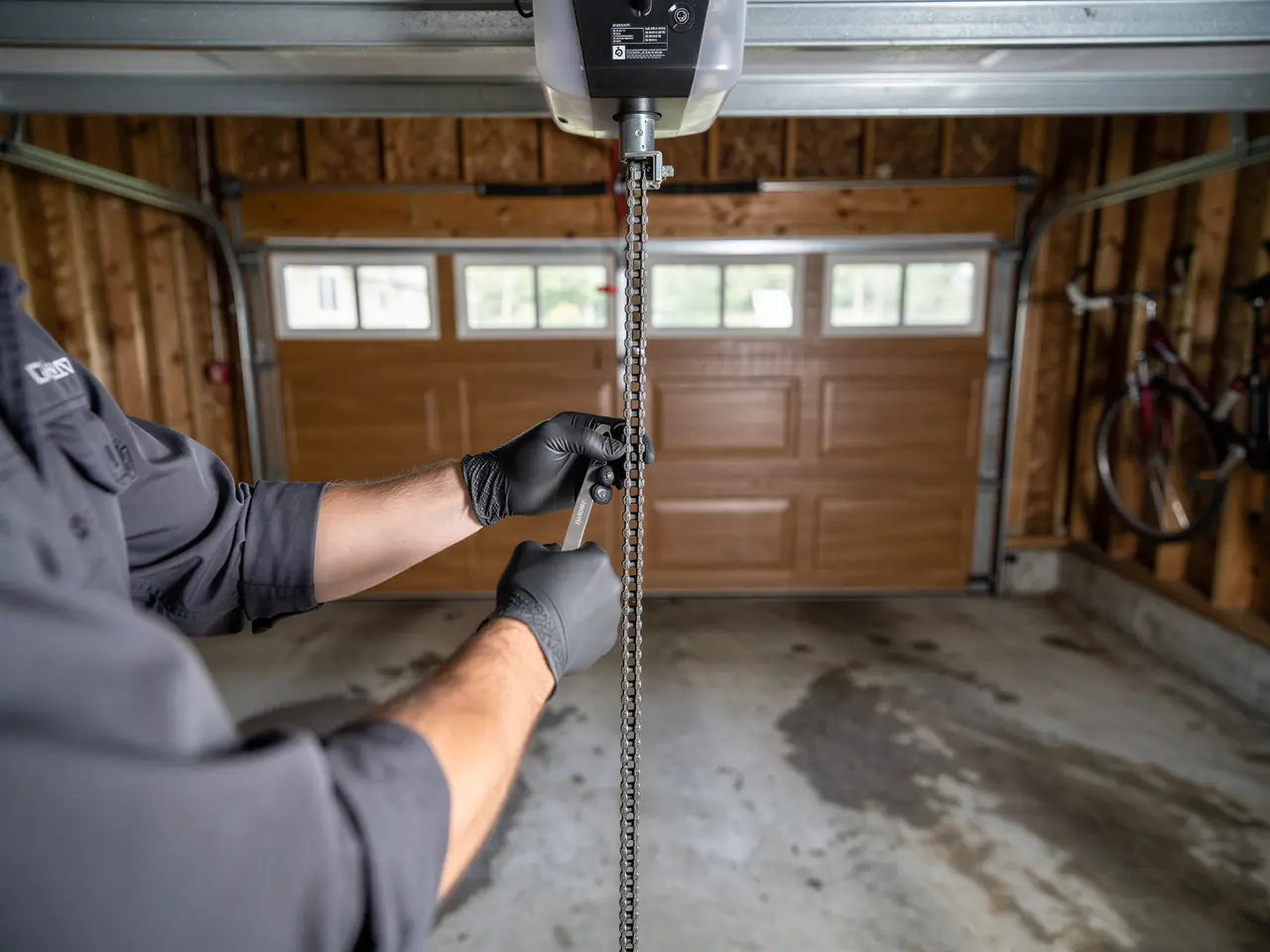
The opener hums but the door doesn't move. The remote works from the driveway but not from the car. The door reverses halfway up, or it opens fine and refuses to close at all. In Topeka, we see a specific pattern tied to the age of the housing stock: a lot of the chain-drive and screw-drive openers installed in homes built between 1961 and 1990 are now 20 to 40 years past their install date, and the circuit boards, capacitors, and drive gears in those units are original or close to it. When a board starts to fail, it rarely dies all at once. It gets intermittent first - works on a cold morning, stutters by afternoon, dead by the weekend. That slow failure is what brings most of these calls in. Sensor misalignment is the other common one: a bumped bracket or a sagging mount on an older frame throws the safety eyes out of line, and the opener refuses to close as a safety default, not a malfunction. Both patterns show up across the service area's older neighborhoods more than in newer construction.
The DIY Question
Some of this is fair to try yourself. Re-aiming safety sensors, cleaning the photo-eye lenses, reprogramming a remote, and checking the wall button wiring are all things an owner can do with a screwdriver and ten minutes. If the opener is dead silent with no light and no hum, check the outlet and the breaker before calling anyone - that's a five-minute fix, not a service call. Where DIY stops making sense is the circuit board and the motor. Those units aren't designed to be opened and diagnosed with a multimeter by someone who doesn't do it daily, and a wrong guess on a board swap can mean buying a second board. If you've reset the travel limits, reseated the sensors, and the door still won't behave the same way twice in a row, that's a logic board or a failing motor capacitor, not a setting.
How We Fix It
We start by running the opener through its full cycle and watching where it hesitates, not just where it stops - half the diagnosis is in the failure point, not the symptom you called about. From there it's usually one of three things: a logic board that's lost its memory under load, a capacitor that's weakened enough to stall the motor on cold mornings (which matters here - this area sits in a cold climate band, and cold makes a marginal capacitor fail faster than it would in a mild one), or a drive gear worn down from thirty-plus years of chain tension. We carry common opener parts on the truck for the brands and drive types that show up most often in this area's housing stock. One honest limit: specialty or discontinued boards for older screw-drive units sometimes have to be special-ordered, and that can mean the fix isn't same-day. When a unit is old enough that the part costs more than half a new opener, we'll tell you that instead of ordering it anyway.
Why This Fails Locally
This isn't a generic opener problem - it's a function of what's actually installed out here. Most of the service area's roughly 3,558 households and 2,382 owner-occupied houses sit in homes built in the 1960s and 70s across the named areas we cover, from Central Topeka and Highland Park out to North Topeka and the surrounding towns. Openers from that era, even replaced ones, were often matched to the original door weight and track geometry, which doesn't always match what's on the door now if the door itself was ever swapped or reinforced. Add the cold band this region sits in and you get motors and capacitors working harder every winter than their rated spec assumes. With a median household income of $71,875 across the area, most owners here are weighing a $40 capacitor against a $300+ full opener swap - and that math is worth doing honestly before any work starts, not after.
Frequently asked questions
Why does my garage door opener work fine in summer but struggle in winter?
Cold makes a weakening motor capacitor fail faster - it has to push harder to start the motor when grease and seals are stiff. In this area's cold climate band, that seasonal swing is common in openers that are already 15-20 years old. If it's stalling more as temperatures drop, the capacitor is usually the first thing to check.
My door closes but then reverses right back up. What's wrong?
That's almost always the safety sensors - either misaligned, dirty, or blocked. The opener is designed to reverse rather than risk closing on something in the doorway, so it's doing its job, just reacting to a sensor problem rather than an obstruction. Re-aiming the two eyes at the bottom of the track usually clears it.
Is it worth repairing an opener from the 1970s or 80s?
Sometimes, sometimes not. If it's a worn gear or a bad capacitor, repair is usually the cheaper route. If the board is discontinued and has to be special-ordered, or the motor itself has failed, a new opener can end up cheaper than chasing parts for a 40-year-old unit. We'll tell you which situation you're in before we order anything.
Do you cover opener repair outside Topeka itself?
We work across the wider service area, including the nearby towns and surrounding neighborhoods we serve. Coverage and response can vary by town, so check your local area page for specifics.
Related services
By Neighborhood
Opener Repair across the Topeka area
We also handle opener repair in these Topeka-area suburbs.
Book garage door service in Topeka
Call now or request a quote - tell us what the door is doing and where you are.