
Topeka, KS · Garage Door Service
Garage Door Maintenance Built Around Topeka's Housing Stock
Garage door maintenance for Topeka's 1960s-80s housing stock, built for the cold snaps that seize springs and openers on original hardware.
- Repairs & new doors
- Springs & openers
- Serving 8 nearby communities
How It Shows Up
Most of the trouble we see starts the same way: a door that used to open smooth now hesitates, grinds, or stutters halfway up. In a service area where housing mostly went up between 1961 and 1990, with a lot of it clustered in the 1960s and 70s, that pattern isn't random. Doors from that era were built with lighter steel, fewer rollers, and openers that have outlived their original relays twice over. A homeowner in one of the nine areas we cover around Topeka will often notice it first as a loud bang on cold mornings, or a door that reverses on its own halfway down. That's not the opener failing out of nowhere - it's decades-old hardware finally telling on itself. We also see uneven wear: one side of the track bent slightly from years of a car clipping it, or a bottom bracket rusted thin from runoff that's been pooling the same spot since the slab was poured. None of this shows up overnight. It builds for years under a schedule of lubrication that never happened, until the day the spring lets go or the cable frays through.
The DIY Question
You can do some of this yourself. Wiping down tracks, checking that the auto-reverse sensors aren't knocked out of alignment, and tightening loose hardware with a socket wrench are all reasonable weekend jobs. What you shouldn't touch is the torsion spring - it's under enough tension to break a bone, and on the older 1960s-70s doors common here, that spring is usually original or close to it, which means it's past due regardless of how it looks. Lubricant matters too: the wrong kind, like a heavy grease on a nylon roller, gums up instead of helping. If your opener is original to a house built in the 1970s and it's starting to strain or stall, that's not a tightening problem, that's an age problem, and no amount of WD-40 fixes a motor that's done its decades of work. Knowing the difference between a five-minute fix and a job that needs a torsion bar clamped and a spring winding bar is most of what keeps people out of the ER.
How We Fix It
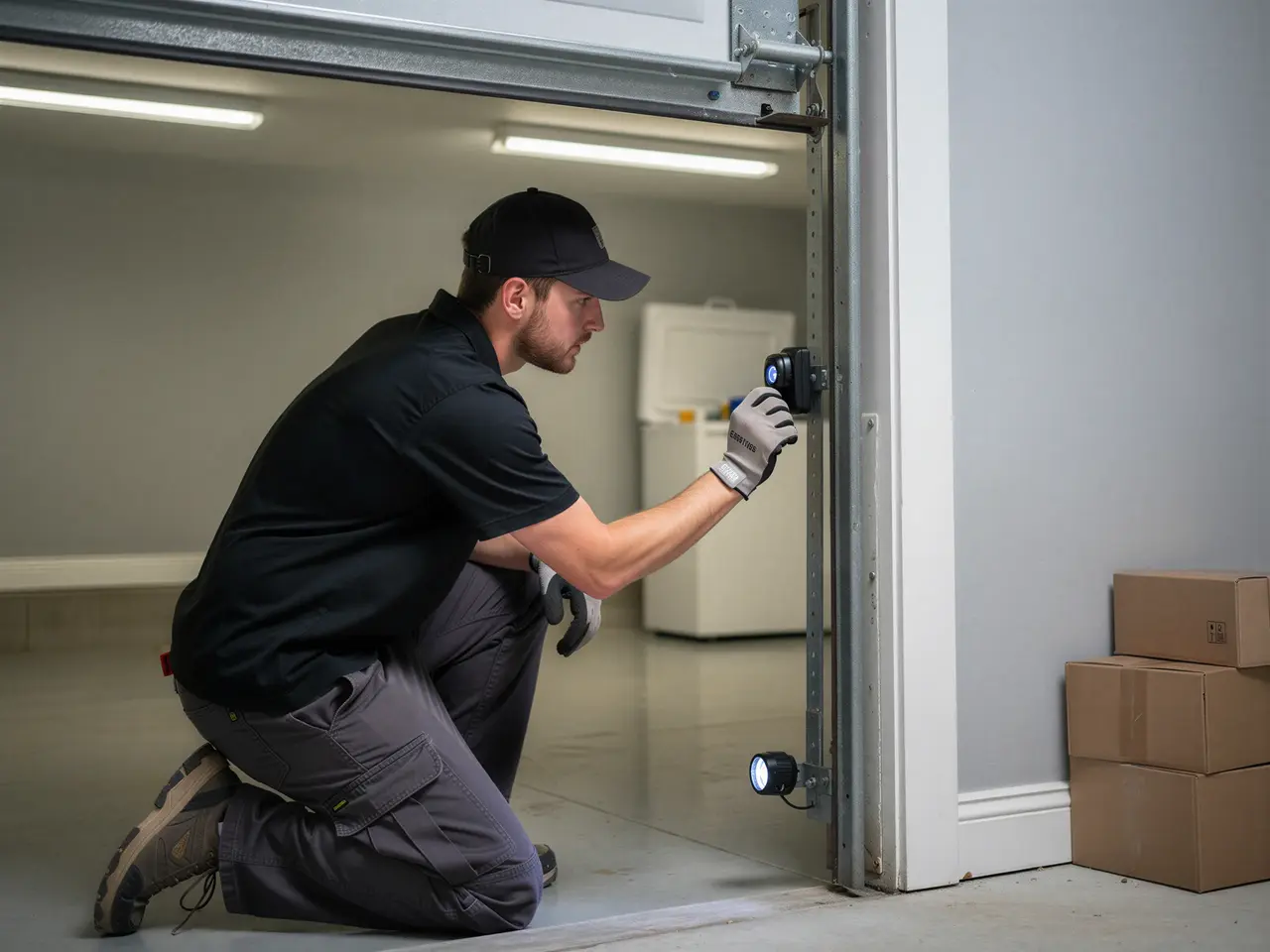
We start with the track and hardware, because on housing this old the fasteners have usually backed out somewhere - a hinge screw stripped, a bracket pulled loose from a jamb that's shifted slightly over sixty years of settling. From there we check spring tension against the door weight, since a lot of original torsion springs in this area were sized for doors that have since been reskinned heavier or had insulation added, which throws off the balance test. We lubricate rollers, hinges, and the torsion bar itself with the right product, not a one-size-can from the shelf. Openers get a look at the drive chain or belt, the limit switches, and the safety sensors - the last one matters more here than in newer construction, since older garages often have the sensors mounted at a height that's no longer code-compliant and needs adjusting during a service visit rather than a full reinstall. We test under load, not just by eye. A door that moves doesn't mean a door that's balanced, and an unbalanced door is what burns out an opener motor early.
Why This Fails Locally
The cold is the part people underestimate. Topeka sits in a moderate-cold climate band, and that matters more for a garage door than most homeowners realize. Steel contracts in the cold, grease thickens, and a spring that was already fatigued from fifty-plus years of cycling is more likely to snap on a January morning than a June afternoon. Combine that with housing built mostly between 1961 and 1990 - median year 1973 - and you've got a huge share of doors in this area running original or near-original torsion hardware that was never engineered for the temperature swings it's seen since. Add in that a lot of these houses have an owner-occupied rate high enough that the same family has lived there for decades, meaning the door has had one owner's maintenance habits its whole life, good or bad. The failure mode isn't mysterious - it's old steel meeting cold weather on a schedule nobody kept. One honest limitation: if a spring has already broken or a panel is bent beyond realignment, maintenance won't save it, and we'll tell you straight when a repair isn't worth it against a replacement.
Frequently asked questions
How often should I get my garage door serviced in Topeka?
Once a year is reasonable for most houses here, especially with the swing between summer heat and winter cold we get. If your house was built before 1990 and the door or opener looks original, we'd lean toward checking it before winter rather than after a cold snap has already stressed the spring.
Is it normal for an older opener to get louder over time?
Some noise increase is normal as chains stretch and gears wear, but a sudden grinding or banging usually means something specific - a stripped gear, a loose sprocket, or a spring losing tension. On openers original to 1960s-70s houses in this area, that noise is often the motor compensating for an unbalanced door.
Can I just replace the spring myself to save money?
We'd advise against it. Torsion springs hold enough stored tension to cause serious injury if the winding bars slip, and on older doors common in this service area the spring size often needs recalculating against the door's current weight, not just swapped for an identical part.
Related services
By Neighborhood
Maintenance across the Topeka area
We also handle maintenance in these Topeka-area suburbs.
Book garage door service in Topeka
Call now or request a quote - tell us what the door is doing and where you are.