
Topeka, KS · Garage Door Service
What a Service Call Actually Covers in Topeka
A look at what a garage door service call actually checks in Topeka homes, most built between 1961 and 1990, and why the cold winters here matter.
- Repairs & new doors
- Springs & openers
- Serving 8 nearby communities
What the Weather Here Does to It
Topeka sits in a cold, moderate climate band, which means the steel and hardware on your door go through a real freeze-thaw cycle every winter, not just a handful of cold snaps. That matters more here than in places with milder swings, because the grease in an opener chain or the lubricant in a torsion spring both stiffen up when the temperature drops hard overnight and then warms during the day.
Most of the housing across the service area - the nine named neighborhoods we cover, from Central Topeka out to North Topeka and East Topeka - went up between 1961 and 1990, with a lot of it clustered in the 1960s and 70s. Doors and openers from that era, or replacements installed to match that era's rough opening sizes, don't always play well with modern weatherstripping or insulation retrofits. A tech checking your door in Topeka is looking at how the panel, the seal, and the track are handling that freeze-thaw stress, not just whether the door opens and closes.
We won't pretend every creak is weather-related. Sometimes a noisy door is just a dry hinge. But if your door binds hard on the coldest mornings of the year and loosens up by afternoon, that's the climate talking, not a defect.
What It Costs
We're not going to list prices here because what a job costs depends on what's actually wrong, and we don't want to quote a number that doesn't match your door. What we can tell you is what drives the cost up or down.
Age of the hardware matters. A lot of homes in this area still run original or early-replacement torsion springs and openers from the 1960s-90s building stock, and parts for some of that older gear take longer to source than parts for anything installed in the last ten years. That lead time, not labor, is usually what separates a same-day fix from a job that takes a few extra days.
What's actually broken matters more than the symptom. A door that won't open could be a $40 sensor alignment or a full spring replacement, and you can't tell which from the driveway. A real service call starts with a diagnosis, not a guess.
Honest limitation: if your door and opener are old enough that the specific roller or hinge spec isn't made anymore, replacement can end up cheaper than chasing a repair. We'll tell you when we think that's the case instead of running up a repair bill on a door that's on its way out anyway.
The Situation
With median household income across the area at $71,875 and roughly 2,382 owner-occupied houses out of 3,558 households, most of the calls we get are from people who own the house and plan to stay in it, not landlords churning tenants. That changes what a service call is for. We're not patching something to get through a showing. We're looking at whether the fix holds for years, given a door that's probably been through three or four decades of Kansas winters already.
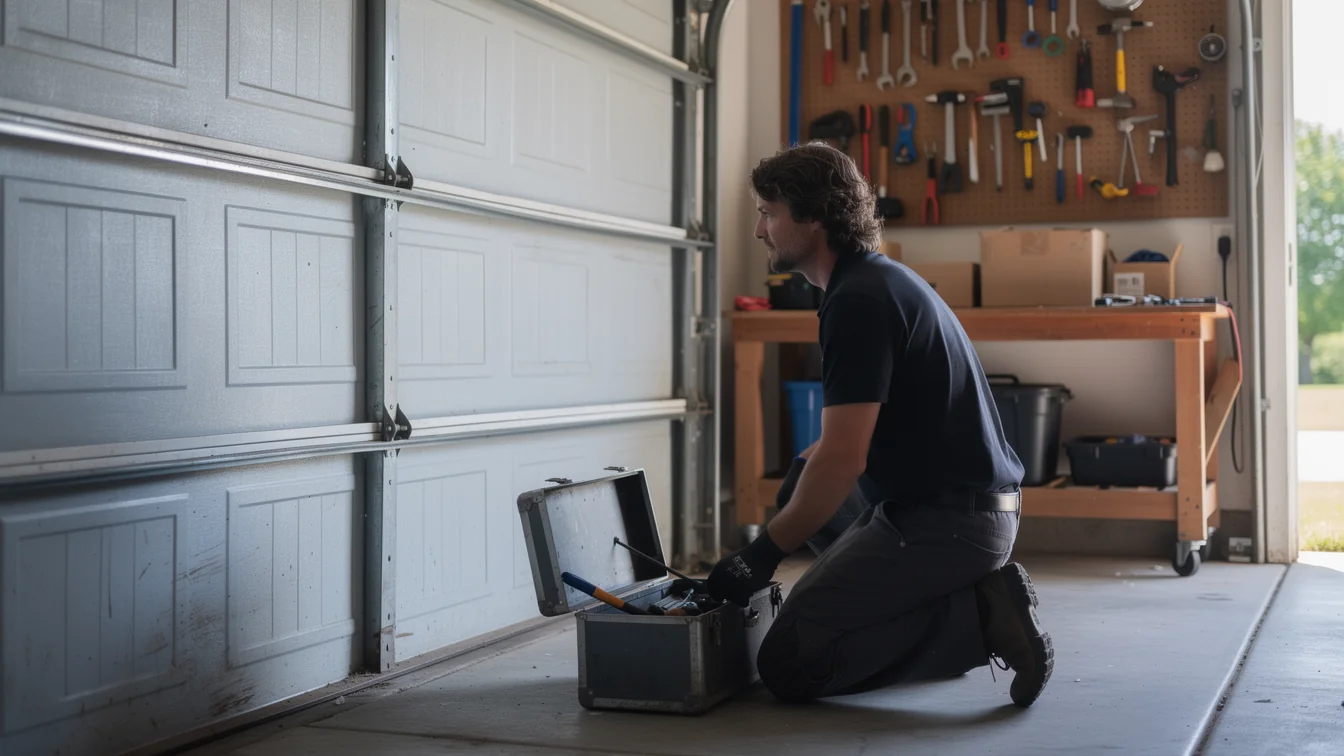
A typical call starts with checking the springs under tension, the cables, the rollers in the track, and the opener's force settings. On a lot of the older stock in Central Topeka, Highland Park, and the North Topeka neighborhoods, we're also checking whether the track is still square, since decades of thermal expansion and contraction can walk a track out of alignment slowly enough that nobody notices until the door starts grinding.
We document what we find before we touch anything, because a spring under full tension is dangerous, and a homeowner should know what's being adjusted and why before a tech starts working.
The Seasonal Bit
The worst time to find out your door has a problem in Topeka is the first hard freeze of the season, because that's when a spring that's been losing tension slowly all year finally gives out. Cold steel is less forgiving than warm steel, and a spring that's limped along fine since spring will often snap the first morning it has to lift a door against stiff, cold air.
If your house falls into that 1961-1990 build window that covers most of the area, fall is the better time to have someone look at the spring tension and the opener's cold-weather performance before winter sets in, not after. We're not going to tell you to do this every single year regardless of how the door's been running - if it's working fine and nothing's binding, you don't need a call just because the calendar changed.
What we do recommend: pay attention to how the door sounds and moves on the first truly cold week each year. That's when problems that were small in October become obvious in December.
Frequently asked questions
Does the cold really affect my garage door that much?
Yes, especially with the freeze-thaw swings typical of this cold moderate climate band. Steel contracts in the cold, lubricants thicken, and springs under tension behave differently at 20 degrees than at 60. If your door struggles only on the coldest mornings, that's a strong sign it's weather, not a broken part.
My house was built in the 1970s. Does that matter for repairs?
It can. A lot of the housing across this service area dates to the 1961-1990 period, and doors or openers original or close to that era sometimes use hardware sizes or mounting styles that aren't standard anymore. It usually just means a slightly longer parts search, not a harder repair.
Can you tell me a price over the phone?
Not accurately. What a repair costs depends on what's actually broken, and that's hard to know without a tech looking at the spring, track, and opener in person. We'll give you a real number after a diagnosis, not a guess before one.
Related garage door services in Topeka
More garage door guides
Book garage door service in Topeka
Call now or request a quote - tell us what the door is doing and where you are.