
Topeka, KS · Garage Door Service
Opener Installation for Perry, KS Homes Built Since the Late 1970s
Perry, KS homes mostly date to the late 1970s, which means openers need matching to original door weight and track, not just bolted in - cold winters add strain.
- Repairs & new doors
- Springs & openers
- Serving 8 nearby communities
What Can Go Wrong
Most houses around Perry went up in the late 1970s - the area's median build year sits at 1978, a few years newer than the 1961-1990 spread across the wider Topeka service area, where the median lands at 1973. That means the garage doors here are mostly original steel sectional doors, single-layer, usually sized for a standard two-car bay, hung on tracks built for the openers that came standard in that era - half-horsepower chain drives, often replaced once already by the time we get a call. What goes wrong isn't exotic: chain drives stretch and start skipping teeth, the logic boards in openers from a decade or two back don't talk to modern remotes or smart-home hubs, and the photo-eye safety sensors bolted low on the track get knocked out of alignment or fail outright. On a door this size and weight, an opener rated too light labors on every lift, burns out its capacitor early, and still won't travel smooth even after you adjust the limit switches.
How We Fix It
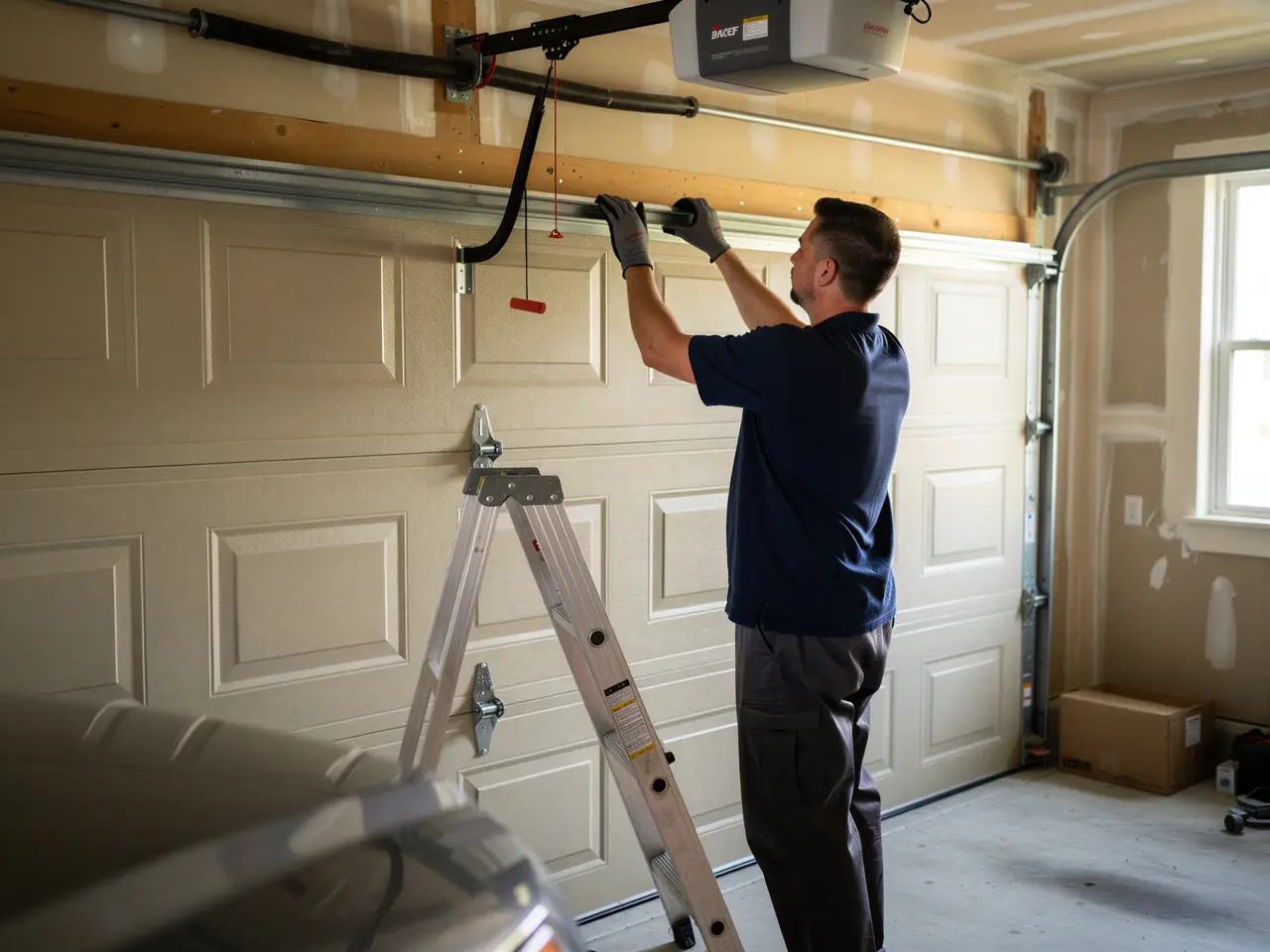
We start by weighing the door, not guessing at it. A single-layer steel door from this era is heavier than the insulated doors sold today, so swapping in an opener means matching horsepower and drive type to what the door actually needs to lift, not just whatever unit is in stock. We set travel limits to the track as it's actually mounted - tracks installed in the late 1970s weren't always squared the way code calls for now - and we re-align the photo-eye sensors so the door reverses properly instead of closing on a parked car or a kid's bike. For chain-drive setups we check tension and replace worn sprockets before they strip the new unit's gear. Belt-drive conversions are an option where the owner wants quiet operation, but we tell people up front: a belt drive on an undersized or warped original track won't run any quieter than the chain it replaced. We test full open-close cycles under load, not just an empty swing, before we call the job done.
Why This Fails Locally
This is a cold-climate area, and that matters more for openers than people expect. Grease in an old chain drive thickens in low temperatures, the motor has to work harder to overcome that resistance, and a unit that was already undersized for the door's weight burns out a season or two sooner than it would in a milder climate. With households here numbering around 429, Perry doesn't generate the call volume to support a local parts stock the way a bigger town might - openers, sensors, and logic boards come out with us from Topeka, seventeen miles down the road, not off a shelf around the corner. That's not a knock on Perry, it's just the math of a small service area: the same doors and the same cold winters as the rest of the region, but fewer trucks passing through on a given week. Original 1970s track hardware also wasn't built to the tolerances current code expects, so on older installs we sometimes find the real fix is re-hanging the track, not just bolting on a new opener and hoping it holds.
What It Costs
We're not going to put a number here we can't back up - opener jobs vary with horsepower, drive type, and whether the track needs correcting along with it, and quoting a flat price before we've seen the door would be a guess dressed up as a fact. What we can tell you is what drives the cost: a straight swap on the opener head is the cheapest end of it, while fixing out-of-square track or old header plates from a 1970s install adds labor on top of the unit price. Perry's median household income runs higher than the broader service area's - $82,589 against $71,875 - and in practice that often means owners here ask for the better-built, quieter units rather than the base model, which changes the number more than any travel charge does. The honest limitation: because we're coming from Topeka rather than working out of a shop in Perry, the quote you get accounts for the trip, and a same-day call isn't something we promise sight unseen.
Parts We Carry
The truck carries what fits what's actually on these doors: half-horsepower and three-quarter-horsepower chain and belt-drive openers sized for single-layer steel sectional doors, standard photo-eye sensor pairs, new drive chains and sprockets, and the wall consoles and remotes that pair with current logic boards. Where we run short is on parts for the original 1970s hardware itself - the heavier gauge track brackets and header mounts that some of these houses still have aren't something any opener installer stocks, original or otherwise, and a part like that sometimes has to be special-ordered rather than pulled off the shelf. If your door needs that kind of bracket work alongside the opener, we'll tell you the lead time rather than promise a same-visit fix. For the opener itself, though, we don't need a special order - horsepower-matched units and sensor kits for a door this age and weight are standard truck stock, and the install gets done once we've confirmed the track is square enough to carry it.
How It Shows Up
Usually it starts small: the door hesitates for a second before it decides to close, or it reverses halfway up for no obvious reason. On a 1970s chain-drive setup, that's often a stretched chain losing tension right where the sprocket catches, and it gets worse, not better, once cold weather sets in and the grease stiffens. Other owners notice the opener runs louder than it used to, a grinding or clicking that wasn't there a year ago - that's usually the gear inside the unit itself wearing down, not something you fix by oiling the track. If the door drops the last foot instead of settling, the travel limits have drifted, which on an older logic board sometimes means the board itself needs replacing rather than just a reset. And if the remote works from the driveway but not from the street, that's a range issue tied to an aging receiver, not anything about distance from Topeka.
Frequently asked questions
Will a new opener work with my old garage door track?
Often yes, but not always without adjustment. A lot of Perry homes still have track hung the way it was installed in the late 1970s, which isn't always squared to current code. We check the track before we mount anything, and if it's out of alignment we'll tell you before the opener goes in, not after.
Why does my opener seem to struggle more in winter?
Cold thickens the grease in an older chain drive and makes the motor work harder to pull the same door it lifted easily in summer. If the opener was already undersized for the door's weight, winter is usually when that shows up as grinding, slow travel, or a motor that won't catch at all.
Do you keep opener parts on hand for homes like mine?
We carry openers, sensors, chains, and sprockets sized for the single-layer steel doors common on houses built around here in the late 1970s. What we don't stock are the original heavier track brackets from that era - those sometimes need to be special-ordered if your job needs them.
Why does the company come from Topeka instead of being based in Perry?
Perry's household count doesn't support a standalone branch the way a larger town does, so the trucks and parts travel out from Topeka, about seventeen miles away. That's factored into the quote, and it's part of why we don't promise a same-day call without seeing the job first.
Book garage door service in Topeka
Call now or request a quote - tell us what the door is doing and where you are.