
Topeka, KS · Garage Door Service
Panel Replacement for Lecompton's 1973-Era Garage Doors
Lecompton, KS homes date to about 1973, which means garage door panels sized for original steel sections, not today's standard widths, delivered from Topeka.
- Repairs & new doors
- Springs & openers
- Serving 8 nearby communities
Parts We Carry
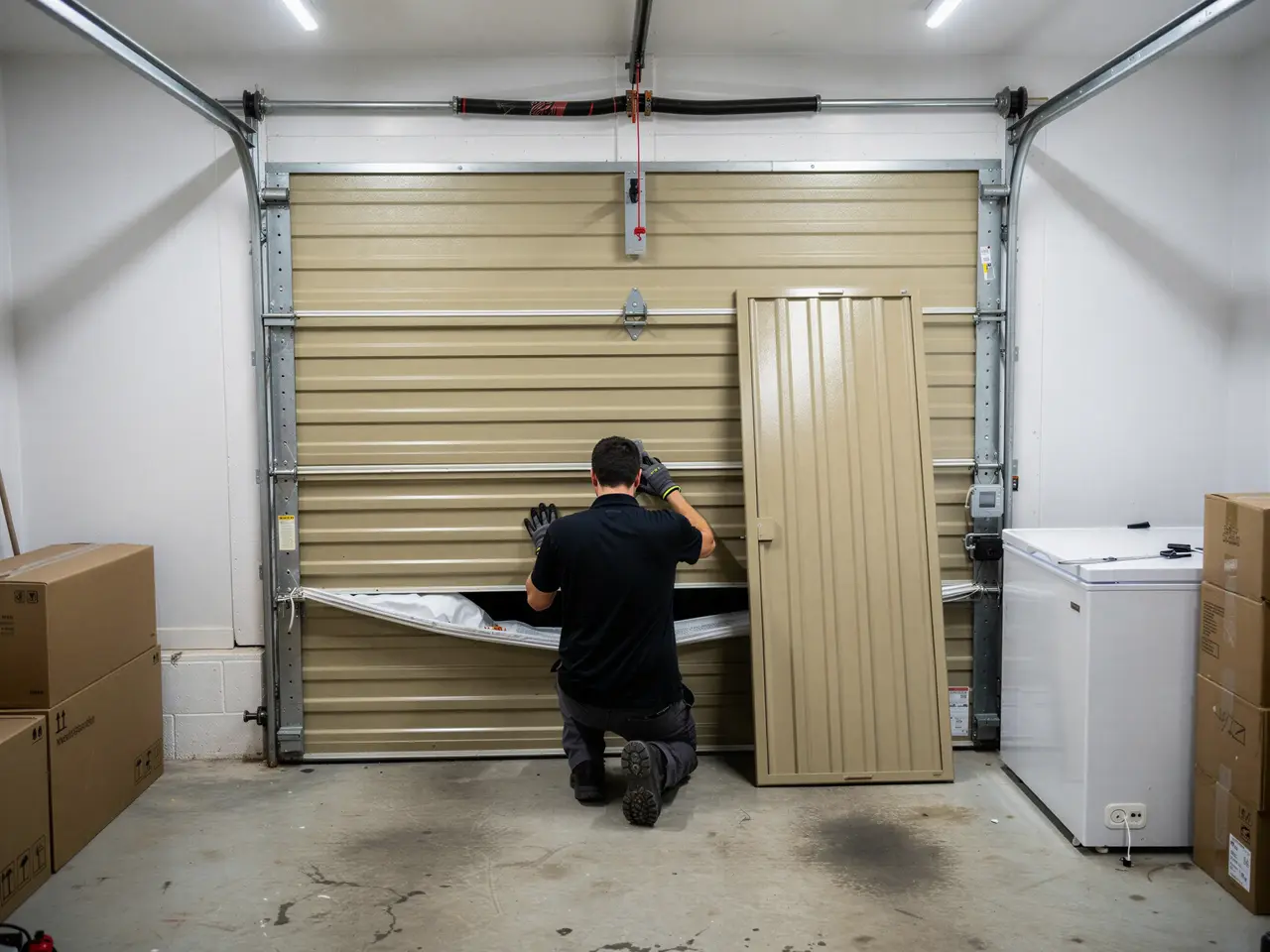
Lecompton's housing stock centers on 1973, which lines up with the service area's overall median build year of 1961-1990 (median 1973) and the mostly 1960s-70s stock found across the Topeka area. That matters for panels. A door from that run is almost always a steel sectional with raised-panel ribbing on a fixed hinge spacing, usually four sections high, often without foam insulation inside the skin. We carry replacement sections sized to that spacing - short panels, long panels, end stiles with the right hinge cutouts, and top sections with window inserts where the original had them. What we can't always do is match the exact rib profile or color from a door that old, since several of those lines were discontinued by the manufacturers years ago. When an exact match isn't out there, we'll tell you straight rather than install something that looks off next to the rest of the door. Sometimes the honest fix is a full door instead of one patched-in panel, and we'd rather say that up front than sell you a mismatch.
What Can Go Wrong
The most common call on a 1973-era steel door is a bottom panel gone soft with rust, usually from years of ground moisture working up through the lowest seam. Second most common: a dent or crease from a mower, trailer hitch, or backed-up car, which on thin uninsulated steel can bow the whole section rather than just dimple it. In this area's cold climate band, the steel also contracts and expands across winter swings, and on a door that's fifty years old that stress tends to show up as hairline cracks along the rib folds, not just at the bottom. Sun fade is its own problem - a replacement panel next to fifty-year-old painted steel rarely matches color even when the rib pattern lines up. None of this is unusual for a door this age; it's just what happens to steel sections that have been through that many winters.
Why This Fails Locally
Lecompton sits about 16 miles out from Topeka, and with roughly 258 households in the area, it's a small enough market that panel stock for a specific 1973-pattern door isn't something anyone keeps sitting on a shelf nearby. That means a trip to pull the right section and drive it out, which is a different planning problem than a same-day swap in town. Household income here runs higher than the wider service area's median of $71,875 - Lecompton's median is $79,375 - and in our experience that often means more owners here want a factory-correct match rather than a visibly different panel bolted onto an otherwise original door. That preference runs straight into the discontinued-parts problem above. The area-wide service footprint covers 3,558 households and 2,382 owner-occupied houses, and across that whole range the 1960s-70s stock is common enough that this isn't a Lecompton-only quirk - it's just concentrated here because of when the area was built.
What It Costs
We don't have a fixed price to put on a panel job here, and we're not going to make one up. What drives the number is almost entirely whether the replacement panel can be sourced close to the original rib pattern and color, or whether the door needs a broader fix because that match doesn't exist anymore. A single bottom panel swap on a door that's otherwise sound is a different job than replacing two sections plus end stiles because the original profile was discontinued. On top of the parts question, a trip to Lecompton from Topeka is part of scheduling the job, not something that changes the panel price itself. The one thing we can say with certainty: we'll look at the actual door, find out what's available for that exact rib spacing, and quote before any work starts - not over the phone from a description.
The DIY Question
Swapping a panel on a 1973-pattern steel door isn't the same as swapping one on a newer door with standardized hardware. The hinge spacing, the rib depth, and the stiffness of that old steel all have to line up with the sections still on the door, or the whole thing can bind on the track or throw the torsion spring's balance off. For a door this old, that balance was set up for the weight of the original panels - swap in something heavier or lighter and the spring is now working against a door it wasn't tuned for. If it's a cosmetic ding on a panel with no structural crease, a careful owner can sometimes get by with a DIY patch kit. But a cracked or rusted-through panel on a door built around original torsion hardware is where we'd tell you to call rather than guess, because getting the balance wrong on an old steel door usually turns into a bigger repair than the panel itself.
Frequently asked questions
Will a replacement panel match my original door?
Sometimes, but not always. Doors built around 1973 often used rib patterns and colors that are no longer made. We'll check the exact profile on your door before quoting, and if an exact match isn't available, we'll tell you so you can decide between a close match or a different scope of work.
How far out do you travel for a Lecompton job?
Lecompton sits about 16 miles from our base in Topeka. We bring the parts and tools out with us rather than stocking a separate location here, which is part of how we schedule the job rather than something that changes once we're on site.
Can I just replace the bottom panel after a car backed into it?
Often, yes, if the rest of the door is structurally sound and we can source a matching section for that rib spacing. If the panel is a discontinued pattern, we'll walk you through whether a close match is acceptable or whether replacing more of the door makes more sense.
Book garage door service in Topeka
Call now or request a quote - tell us what the door is doing and where you are.